Jiabao Hu, Weiwei Ni, Mengting Han, Yunzhen Zhan, Fei Li, Hui Huang and Jinsong Han
J. Mater. Chem. B, 2025,13, 207-217
DOI:
10.1039/D4TB01861C,
Paper


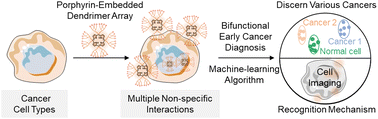
Early cancer detection plays a vital role in improving the survival rate of cancer patients, underscoring the importance of developing cancer detection methods. However, it is a great challenge to achieve simple, rapid, and accurate methods for simultaneously discerning various cancers. Herein we developed a 5-element porphyrin-embedded dendrimer-based sensor array, targeting the parallel discrimination of multiple cancers. The porphyrin-embedded dendrimers were modified with various functional groups to generate differentiated interactions with diverse cancer cells, which has been validated by fluorescence responses and laser confocal microscopy imaging. The dual-channel, five-element array, featuring ten signal outputs, achieved 100% accuracy in distinguishing between one human normal cell and six human cancerous cells, as well as in differentiating among mixed cells. Moreover, the screen 6-channel array can accurately distinguish 9 cells from mice and humans in minutes through optimization by multiple machine learning algorithms, including two normal cells and 7 cancerous cells with only 1000 cells, highlighting the significant potential of a porphyrin-embedded dendrimer-based parallel discriminating platform in early cancer diagnosis.