R. D. Astumian
Chem. Commun., 2018,54, 427-444
DOI:
10.1039/C7CC06683J,
Feature Article


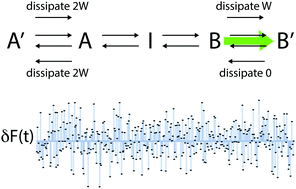
In the absence of input energy, a chemical reaction in a closed system ineluctably relaxes toward an equilibrium state governed by a Boltzmann distribution. The addition of a catalyst to the system provides a way for more rapid equilibration toward this distribution, but the catalyst can never, in and of itself, drive the system away from equilibrium. In the presence of external fluctuations, however, a macromolecular catalyst (e.g., an enzyme) can absorb energy and drive the formation of a steady state between reactant and product that is not determined solely by their relative energies. Due to the ubiquity of non-equilibrium steady states in living systems, the development of a theory for the effects of external fluctuations on chemical systems has been a longstanding focus of non-equilibrium thermodynamics. The theory of stochastic pumping has provided insight into how a non-equilibrium steady-state can be formed and maintained in the presence of dissipation and kinetic asymmetry. This effort has been greatly enhanced by a confluence of experimental and theoretical work on synthetic molecular machines designed explicitly to harness external energy to drive non-equilibrium transport and self-assembly.