


NiFe alloy nanocrystals anchored on nitrogen-doped carbon: interface engineering for enhanced peroxymonosulfate activation via non-radical dominated pathways
 *bcd
*bcd
Abstract
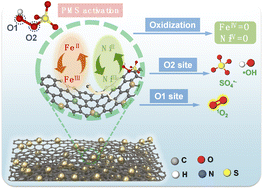
Peroxymonosulfate (PMS) activation based on non-radical oxidation has emerged as a highly efficient and feasible strategy for wastewater treatment. Herein, heterogeneous catalysts with NiFe alloy nanocrystals anchored on nitrogen-doped carbon (NiFe–N-C) were rationally designed and fabricated to activate PMS for the degradation of tetracycline (TC). The NiFe–N-C/PMS catalytic system achieved 93.3% TC removal and 79.8% PMS utilization within 60 minutes, outperforming analogous catalytic systems previously reported. Notably, the system exhibited strong anti-interference against various anions and humic acid (HA) and maintained high catalytic activity over a broad pH range, highlighting its strong adaptability to complex practical water environments. Singlet oxygen (1O2) and high-valent metal species (HVMSs) were identified as the dominant oxidants for TC degradation. DFT calculations further revealed that the Ni/Fe dual active sites served as the dominant catalytic centers in NiFe–N-C, which could reduce the energy barrier for O–O bond cleavage of PMS, thereby facilitating the formation of NiFeIV![[double bond, length as m-dash]](https://www.rsc.org/images/entities/char_e001.gif) O species and 1O2. Additionally, the N-C matrix stabilizes NiFe alloy nanocrystals through the formation of strong surface N–M bonds, while enabling rapid interfacial electron transfer in the catalytic system. Finally, comprehensive analyses of degradation pathways and toxicity evaluations confirmed the environmental safety of the catalytic process. This study provides a theoretical basis for high-performance non-radical catalytic system design and lays a foundation for their practical application in water pollution control.
O species and 1O2. Additionally, the N-C matrix stabilizes NiFe alloy nanocrystals through the formation of strong surface N–M bonds, while enabling rapid interfacial electron transfer in the catalytic system. Finally, comprehensive analyses of degradation pathways and toxicity evaluations confirmed the environmental safety of the catalytic process. This study provides a theoretical basis for high-performance non-radical catalytic system design and lays a foundation for their practical application in water pollution control.
- This article is part of the themed collection: Advances in Sustainable Catalysis: from Materials to Energy and Environmental Applications
 Please wait while we load your content...


