


Property modulation of poly(vinyl alcohol)s via controlled incorporation of α-methyl groups using alkenylboron monomers
 *a
and
Makoto
Ouchi
*a
*a
and
Makoto
Ouchi
*a
Abstract
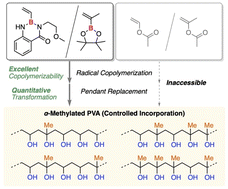
Radical copolymerization of vinyl- and isopropenyl-type boron monomers followed by side-chain oxidation enabled the synthesis of α-methylated poly(vinyl alcohol)s (PVAs), which are difficult to obtain by conventional methods. The composition ratio of the resulting vinyl alcohol (VA)–isopropenyl alcohol (IPA) copolymers was tunable in a wide range (VA/IPA = 84/16–7/93 mol%) by adjusting the monomer feed ratio in the copolymerization step. All copolymers were amorphous in the bulk state regardless of their composition ratios, despite the semi-crystalline nature of both VA and IPA homopolymers. In solution, copolymers with specific compositions exhibited solvent-dependent thermal-responsive behavior: lower critical solution temperature (LCST)-type transitions in water and upper critical solution temperature (UCST)-type transitions in acetone.
- This article is part of the themed collections: Polymer Chemistry Open Access Spotlight 2026 and Polymer Chemistry Emerging Investigators Series
 Please wait while we load your content...


