


Emerging investigator series: environmental safety assessment of 11 novel metal oxide/hydroxide nanocomposite adsorbents for advanced magnetic removal and recovery of phosphorus from wastewater

Abstract
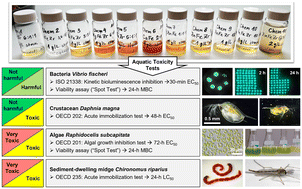
This study evaluated the ecotoxicity of 11 metal oxide/hydroxide nanocomposite adsorbents for advanced magnetic removal/recovery of phosphorus from wastewater using four test organisms representing different aquatic trophic levels: bacteria Vibrio fischeri, crustaceans Daphnia magna, algae Raphidocelis subcapitata and midge Chironomus riparius larvae. The nanocomposites (d50 < 10 μm) were synthesized as co-precipitates of 2-, 3- and/or 4-valent metal precursors (Zn2+, Ca2+, Mg2+, Fe3+, Zr4+) at varying molar ratios. The shedding of precursor metals in toxic concentrations was observed only for the Zn-containing adsorbents. The acute toxicity of the Zn-containing composites ranged from “harmful” to bacteria (10 < 30 min EC50 ≤ 100 mg L−1), “toxic” to crustaceans (1 < 48 h EC50 ≤ 10 mg L−1) and “very toxic” to midge larvae and algae (24 h LC50 ≤ 1 mg L−1). As a rule, their toxicity correlated with the concentration of shed Zn-ions. All nanocomposites, regardless of their composition, proved very toxic to algae, i.e. remarkably inhibited algal growth (72 h EC50 ≤ 1 mg L−1). The latter effect could be explained by (i) shed Zn-ions in case of Zn-containing materials as algae are very sensitive to heavy metals, (ii) composites-induced phosphorus removal from the algal growth medium and (iii) entrapment of algal cells into particle agglomerates. Importantly, the most-promising benchmark material ZnFeZr-6 : 1 : 1 (V. fischeri EC50 = 118 mg L−1; D. magna EC50 = 7.7 mg L−1; C. riparius LC50 = 0.59 mg L−1) proved safe for bacteria and crustaceans once deposited on magnetic particles ZnFeZr-6 : 1 : 1@MPs yielding EC50 > 100 mg L−1. Summing up, although Zn enhances the adsorbent selectivity and reusability, all Zn-containing P-adsorbents are questionable in terms of ecosafety and thus not recommended for engineering applications in open systems.
- This article is part of the themed collections: Recent Open Access Articles - Environmental Science: Nano and Emerging Investigators Series
 Please wait while we load your content...


