


Unveiling hydrogen-source-dominated CO2 electroreduction activity on nitrogen-doped carbon nanotubes

Abstract
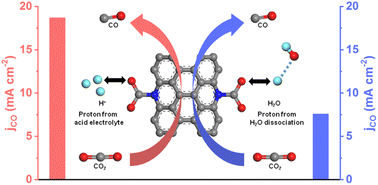
In general, the activation of CO2—rather than the availability of hydrogen source—is considered to be the determining step in electrocatalytic CO2 reduction reaction (eCO2RR) processes. However, the dissociation of H2O, which is the dominant hydrogen source in most metal-based catalysts for the eCO2RR in alkaline/neutral and even acidic electrolytes, suffers from the challenges of high dissociation barrier and carbonate formation. Herein, we design nitrogen-doped carbon nanotubes (N-CNTs). N-CNTs possess weak H2O dissociation ability and can switch the hydrogen source from the dissociation of H2O to hydrated protons, thereby greatly enhancing the eCO2RR activity. In situ characterization and theoretical calculations confirm that the protons, rather than H2O, act as the hydrogen source on the N-CNTs catalyst in an acidic electrolyte, which boosts the proton-coupled electron transfer process of *COOH formation and lowers the eCO2RR barrier. Impressively, N-CNTs exhibit a remarkable faradaic efficiency of CO (FECO) at current densities ranging from −50 to −350 mA cm−2 and sustained FECO at 200 mA cm−2, outperforming most reported carbon catalysts. These findings identify the hydrogen source pathway as a new activity-tuning parameter for the eCO2RR, paving a new path for the design of efficient electrocatalytic systems.
- This article is part of the themed collection: 2025 Chemical Science HOT Article Collection
 Please wait while we load your content...


