



Run-and-tumble particles learning chemotaxis

Abstract
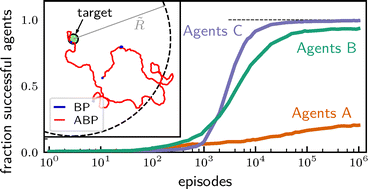
Through evolution, bacteria have developed the ability to perform chemotactic motion in order to find nourishment. By adopting a machine learning approach, we aim to understand how this behavior arises. We consider run-and-tumble agents able to tune the instantaneous probability of switching between the run and the tumble phase. When such agents are navigating in an environment characterized by a concentration field pointing towards a circular target, we investigate how a chemotactic strategy may be learned starting from unbiased run-and-tumble dynamics. Target detection is allowed only during the tumble phase, which qualifies our agents as truly intermittent searchers. We compare the learning performances of agents that sense only the instantaneous concentration with those of two types of agents both having a short-term memory that allows them to perform temporal comparisons. While all types of learning agents develop successful target-search policies, we demonstrate that those achieved by agents endowed with temporal comparison abilities are significantly more efficient, particularly when the initial distance from the target is large. Finally, we also show that when an additional length scale is imposed, for example by fixing the initial distance to the target, the learning agents can leverage this information to further improve their efficiency in locating the target.
- This article is part of the themed collection: Soft Matter Open Access Spotlight
 Please wait while we load your content...


