


Size matters: limitations of the ZIF-8 monolith and its Ni-, Co- and Cu-doped variants for the adsorption of rhodamine B
 *a
Susann
Frenzke,
a
Luis de los Santos
Valladares,
bc
Thomas F.
Keller,
ef
Henry Sanchez
Cornejo,
bg
Dina
Huanaco-Quispe,
h
Lina Maria
Asprilla-Herrera,
j
Weronika
Łukaszczyk,
k
Simone
Techert
am
*a
Susann
Frenzke,
a
Luis de los Santos
Valladares,
bc
Thomas F.
Keller,
ef
Henry Sanchez
Cornejo,
bg
Dina
Huanaco-Quispe,
h
Lina Maria
Asprilla-Herrera,
j
Weronika
Łukaszczyk,
k
Simone
Techert
am
Abstract
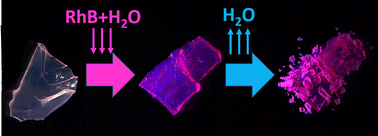
Despite numerous publications reporting the instability of ZIF-8 in water, it is still used for water purification, including the adsorption of molecules significantly larger than the pore window. This work involves the synthesis, characterisation and application of ZIF-8 monoliths, including those doped with Ni, Co and Cu at levels of 4%, 8% and 12%, for rhodamine B adsorption in water. Characterisation techniques include optical microscopy, PXRD, FTIR, SEM-EDX, TGA-FTIR and N2 adsorption. The results reveal mm-cm sized monoliths with an identical crystalline structure and morphology, but different properties depending on the doping metal and level. Except for 4% of Co-doped ZIF-8, doping generally narrows the pore size distribution to micropores (maximum between 10.9 and 11.6 Å), whereas the undoped monolith shows a combination of micropores and mesopores (10.2–38 Å). Doping with more than 4% Co2+ or Cu2+ results in higher BET surface areas (up to 1180 and 1100 m2 g−1, respectively) compared to the undoped monolith (960 m2 g−1). However, when immersed in a 10 mg L−1 rhodamine B solution, all monoliths exhibit both slower adsorption kinetics and reduced capacities (0.61 and 1.82 mg g−1) compared to the reported nano-/microsized particles. Desorption of rhodamine B occurred between 9 and 24 h, attributed to up to 20% degradation of the monolith. Immersion in Milli-Q water for five days led to a white residue on the surface, with FTIR indicating a new phase. These results suggest that ZIF-8 and its variants are unsuitable for adsorbing large molecules in water but are suitable for small molecules like gases.
- This article is part of the themed collection: Materials Advances Covers
 Please wait while we load your content...


