


Detection of unlabeled nanoplastics within Daphnia magna using enhanced darkfield hyperspectral microscopy

Abstract
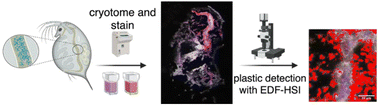
The ubiquity of small plastic particles in the environment compels researchers to better understand their ecotoxicity, hence motivating the need for advanced methods to localize plastic particles within whole organisms. Nanoplastics (<∼1 μm) have proven particularly challenging to detect due to their small size, which has limited our understanding of their potential for biouptake and subsequent impacts. To address this research gap, this work focuses on detecting internalized plastic particles in a model freshwater organism (Daphnia magna) using a combination of histology and enhanced darkfield hyperspectral imaging (EDF-HSI). A cryotome was used to obtain histological slices of the whole organism and minimize the interference of biological tissue that impairs the visualization of plastic particles. Furthermore, this study presents a method to modify the spectral response of biomass using hematoxylin and eosin staining. The incorporation of the staining protocol with EDF-HSI enables the detection of ingested plastic particles, such as polystyrene, polyethylene, polymethyl methacrylate, polyvinylchloride, and polytetrafluoroethylene. The results demonstrate the detection of nanoplastics as small as 500 nm at low exposure concentrations (0.01 ppm). A key advantage of this method is that plastics do not need to be pre-labeled prior to internalization by organisms. This makes it a promising methodology for ecotoxicology studies since ingested unlabeled microplastics and nanoplastics can be localized inside an organism. The proposed method using EDF-HSI combined with biomass staining to analyze histological slices for the localization of nanoplastics within whole organisms will aid in improving our understanding of the fate and impacts of plastic pollution.
- This article is part of the themed collections: HOT articles from Environmental Science: Nano, Nanoplastics in the Environment and Recent Open Access Articles - Environmental Science: Nano
 Please wait while we load your content...


