Surface-chemistry-controlled growth of NiBDC on carbon nanotubes governs urea oxidation activity

Abstract

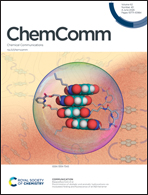
CNT surface chemistry dictates NiBDC growth and UOR performance. –OH groups preserve the CNT structure and enhance electron transfer; –NH2 triggers carbothermal reduction to Ni0, disrupting graphitic order; and pristine CNTs provide weak π–π interactions. The –OH catalyst achieves 10 mA cm−2 at 1.328 V, establishing a key surface–activity relationship.

Graphical abstract: Surface-chemistry-controlled growth of NiBDC on carbon nanotubes governs urea oxidation activity

Supplementary files

Transparent peer review

To support increased transparency, we offer authors the option to publish the peer review history alongside their article.

View this article’s peer review history

Article information

Article type
Communication
Submitted
11 May 2026
Accepted
19 May 2026
First published
25 May 2026

Chem. Commun., 2026, Advance Article

Surface-chemistry-controlled growth of NiBDC on carbon nanotubes governs urea oxidation activity

D. Meng, J. Luo, L. Tao, X. Tong and M. Wu, Chem. Commun., 2026, Advance Article , DOI: 10.1039/D6CC02905A

To request permission to reproduce material from this article, please go to the Copyright Clearance Center request page.

If you are an author contributing to an RSC publication, you do not need to request permission provided correct acknowledgement is given.

If you are the author of this article, you do not need to request permission to reproduce figures and diagrams provided correct acknowledgement is given. If you want to reproduce the whole article in a third-party publication (excluding your thesis/dissertation for which permission is not required) please go to the Copyright Clearance Center request page.

Read more about how to correctly acknowledge RSC content.

Social activity

Spotlight

Advertisements