


Molecular origin of negative lithium transference in electrolytes with star-shaped multivalent anions

Abstract
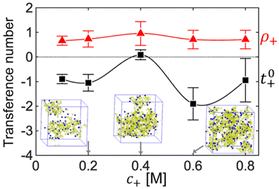
Large multivalent anions have gained increasing attention for their potential to improve lithium transference in electrolytes. We employ large-scale molecular dynamics simulations based on the Onsager transport framework to investigate ion transport in a lithium electrolyte with star-shaped multivalent anions. The simulations show that t0+, the cation transference number with respect to solvent velocity, is negative over a wide range of concentration. This is consistent with experimental data reported previously. The simulation-based Onsager transport coefficients reveal that the magnitudes of the cation–cation, anion–anion, and cation–anion correlations are comparable, a signature of highly correlated motion in the electrolyte. Examination of the cation solvation environment indicates the presence of strong cation–anion association across the entire concentration range, which leads to negative t0+ on the order of −1. Both simulation and experiment also show that the maximum value of t0+ reaches 0 when the cation concentration is c+ = 0.4 M. This is the concentration at which the anions begin to spatially overlap, and lithium ions serve as dynamic linkers to balance cation–cation and cation–anion correlations. Our results provide molecular-level insights into the origin of transference in multivalent electrolytes.
- This article is part of the themed collection: Journal of Materials Chemistry A Emerging Investigators 2026
 Please wait while we load your content...


