



Advancing the self-assembly of binary colloidal crystals of tetrahedra and octahedra with confinement

Abstract
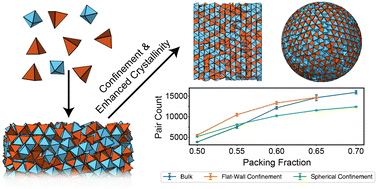
Photonic crystals can be self-assembled from binary colloidal dispersions, but the robust assembly of high-quality crystals in quantities sufficient for large-scale applications remains challenging. Here, we study the assembly of polyhedral colloidal nanoparticles at surfaces with spherical and flat-wall geometries to examine the influence of confinement on the process and products of crystallization compared to the bulk. We find that confinement improves crystallization at non-ideal stoichiometries but does not lower the minimal packing fraction at which crystallization occurs. Crystals formed in confinement exhibit higher degrees of crystallinity and lower quantities of secondary-phase defects: the formation of well-ordered layers and shells appears to be promoted by flat walls and spherical container interfaces. These findings demonstrate the potential for enhanced control over the synthesis of novel materials with tailored structures and properties for photonic applications.
- This article is part of the themed collections: Foundations of Molecular Modeling and Simulation - FOMMS 2024 and MSDE Open Access Spotlight
 Please wait while we load your content...


