Zu-Sheng Huang, Herbert Meier and Derong Cao
J. Mater. Chem. C, 2016,4, 2404-2426
DOI:
10.1039/C5TC04418A,
Review Article


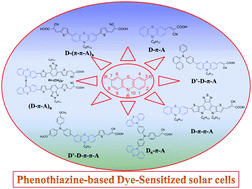
As an emerging photovoltaic technology, dye-sensitized solar cells (DSSCs) have attracted a great deal of academic and industrial interest due to their reasonably high power conversion efficiency, low material cost and facile fabrication process. Metal-free organic dyes, as one of the key components of DSSCs, play a pivotal role in light harvesting and electron injection. Among the various species of organic dyes, easily tunable 10H-phenothiazine-based dyes hold a large proportion. The electron-rich nitrogen and sulfur atoms render 10H-phenothiazine a stronger donor character than other amines, even better than triphenylamine, tetrahydroquinoline, carbazole and iminodibenzyl. On the other hand, the unique non-planar butterfly conformation of the 10H-phenothiazine ring can sufficiently suppress molecular aggregation and the formation of excimers. The positions N-10, C-3 and C-7 of the 10H-phenothiazine ring system can easily be furnished with electron-donating or electron-withdrawing groups. Thus, the structural features of 10H-phenothiazine-based dyes guarantee the fabrication of efficient DSSCs. Some 10H-phenothiazine-based dyes show high photovoltaic performance, even better than the commercial ruthenium complex (N719). This paper reviews the recent significant scientific progress in 10H-phenothiazine-based DSSCs and focuses especially on the relationship between the molecular structure and the photoelectric conversion properties.