


Local spin and open quantum systems: clarifying misconceptions, unifying approaches†
 ‡*a
and
‡*a
and
Abstract
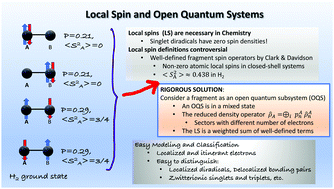
The theory of open quantum systems (OQSs) is applied to partition the squared spin operator into fragment (local spin) and interfragment (spin-coupling) contributions in a molecular system. An atomic or fragment subsystem is described by a quantum mechanical mixed density operator composed of sectors, characterized by different integer number of electrons that appear with specific probabilities. The OQS fragment spin operators coincide with those defined by Clark and Davidson in their paper on local spins (J. Chem. Phys., 2001, 115, 7382) and are fully consistent with the theory of local operators by Stollhoff and Fulde (J. Chem. Phys., 1980, 73, 4548). OQSs provide a unique way to rationalize the non-zero values of local spins found in closed-shell molecules, a fact that has led to a large number of modified definitions being proposed, which we show suffer from inconsistencies. The OQS viewpoint makes it easy to build models for localized and itinerant spins. These models are used to classify possible local spin arrangements. The role of electron correlation is also studied through the analysis of the Hubbard Hamiltonian in small chains. Local spins result from a game played differently by localized and delocalized electrons. A number of examples exemplifying the ability of the OQS local spin perspective to uncover simple chemical patterns are examined.
- This article is part of the themed collections: Quantum computing and quantum information storage: Celebrating the 2022 Nobel Prize in Physics and Quantum Computing and Quantum Information Storage
 Please wait while we load your content...


