


Advancing Fe–N–C catalysts: synthesis strategies and performance enhancements for fuel cell applications
 *ab
*ab
Abstract
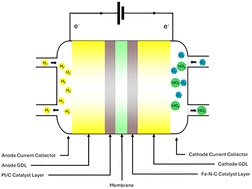
Fe–N–C catalysts have emerged as the most promising class of non-precious metal electrocatalysts for the oxygen reduction reaction (ORR) in proton exchange membrane fuel cells (PEMFCs), offering favourable activity, structure tunability, and cost-effectiveness. However, challenges remain in achieving the performance and durability required for practical applications. This review systematically summarizes recent progress in Fe–N–C catalyst development, with a focus on synthetic strategies aimed at increasing the active site density, optimizing Fe–Nx coordination environments and potential engineering solutions to the membrane electrode assembly (MEA) based on Fe–N–C, particular attention is given to the pyrolysis atmosphere control, post-synthesis treatment, and optimizing the microstructure and catalytic performance. Furthermore, this review explores emerging approaches to integrate Fe–N–C catalysts into membrane electrode assemblies (MEAs), including ionomer–catalyst interaction tuning and electrode architecture optimization, with the goal of bridging the gap from laboratory activity to real-world fuel cell operation.
- This article is part of the themed collection: Research advancing UN SDG 7: Affordable and clean energy
 Please wait while we load your content...


