


Revealing the impact of Na–Ag single-site Co-doping in CZTSSe
 *a
and
Paul
Mulvaney
*b
*a
and
Paul
Mulvaney
*b
Abstract
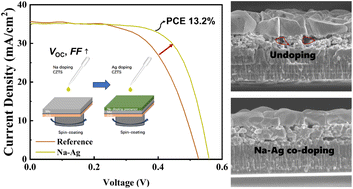
Cation doping/substitution is a widely used strategy to overcome the serious open-circuit voltage deficit caused by unfavorable defects and defect clusters in kesterite materials such as CZTSSe. Single cation substitution has proved effective in improving PV performance. However, single element doping of CZTSSe has its own limitations because dopants can reduce carrier concentrations and introduce unfavorable lattice distortion. Co-doping offers broader possibilities for regulating the optoelectronic properties of CZTSSe materials but has seldom been explored due to the enhanced complexity in such systems. Herein, a single-site, co-doping strategy is proposed using Na and Ag ions, which both target the same copper lattice site in CZTSSe. The Na+ ions passivate Cu-related defects while the introduction of Ag+ reduces the lattice distortion that the Na ions create. Conversely, Na ions help to compensate for the reduction in carrier concentration caused by Ag+ doping. Furthermore, the synergistic doping of Na and Ag also promotes the crystal growth of the absorption layer, resulting in a compact, large-grain absorption layer and enhancing the performance of the device. After optimization, we achieved a Voc of 559 mV and a fill factor (FF) of 67.3% and an overall power conversion efficiency of 13.2%.
- This article is part of the themed collection: Emerging Inorganic Materials for Solar Harvesting
 Please wait while we load your content...


