


Polymer-modified nonwovens: functional surfaces for separation, sensing, biomedical and smart textile applications

Abstract
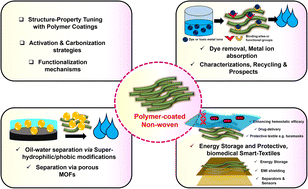
Abstract nonwoven fabrics have rapidly evolved from low-value commodities into next-generation materials platforms underpinning healthcare, environmental remediation, and clean-energy technologies. Yet, their intrinsic limitations such as poor surface activity, weak durability, and restricted functionality, have constrained their deployment in high-performance systems. Polymer modifications have emerged as a transformative strategy, redefining the interface between fibrous architecture and external stimuli to unlock multifunctionality far beyond the capabilities of the base fibers. This review provides a comprehensive and mechanistic understanding of polymer-modified nonwovens, integrating fiber chemistry, coating design, and structure–property correlations. It critically dissects coating chemistries ranging from fluoropolymers, polyurethanes, acrylics, and silicones to emerging polysilazanes, biopolymers, and conductive polymers. The discussion extends to advanced thermal engineering routes of the nonwovens via carbonization and activation providing nonwovens with hierarchical porosity, conductivity, and catalytic activity for energy and environmental applications. Recent progress in surface-engineering strategies enabling superhydrophobic, antimicrobial, flame-retardant, adsorptive, and electrically conductive functions is systematically analyzed, linking interfacial chemistry to macroscopic performance. Representative case studies across oil–water separation, toxic-ion removal, wound healing, protective clothing, electromagnetic shielding, and energy-storage devices are highlighted to illustrate the cross-sectoral versatility of polymer-nonwoven composites. Finally, critical challenges including the absence of quantitative structure–function models, limited scalability, and sustainability gaps are identified. A forward-looking roadmap is proposed toward circular, adaptive, and multifunctional nonwoven systems that bridge polymer science, materials engineering, and environmental sustainability, positioning polymer-modified nonwovens as a unifying framework for future smart and sustainable material technologies.
- This article is part of the themed collection: Journal of Materials Chemistry A Recent Review Articles
 Please wait while we load your content...


