


Development and modification of porous polymer structures in the vicinity of cellulose fibers
 a
Sebastian
Heinz,
a
Waranya
Limprasart,
b
Suteera
Witayakran,
ad
Samuel
Schabel,
c
Volker
Presser,
efg
Torsten
Gutmann
*bh
and
Markus
Gallei
*ag
a
Sebastian
Heinz,
a
Waranya
Limprasart,
b
Suteera
Witayakran,
ad
Samuel
Schabel,
c
Volker
Presser,
efg
Torsten
Gutmann
*bh
and
Markus
Gallei
*ag
Abstract
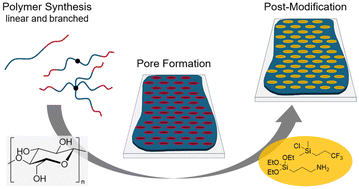
In this work, hierarchically porous materials have been prepared by the self-assembly and pore formation of different amphiphilic block copolymers (BCPs) in the vicinity of cellulose paper sheets. For this, polystyrene-block-polysolketal methacrylate (PS-b-SMA) as a linear BCP and polymethyl methacrylate-block-polysolketal methacrylate (PMMA-b-SMA)n as a star-shaped BCP were prepared using living anionic polymerization. Under mild acidic conditions, the amphiphilic properties were revealed by converting the PSMA block segment to poly(dihydroxypropyl methacrylate) (PDHPMA). The BCPs were incorporated onto cellulose linters fiber-based sheets by a self-assembly and nonsolvent-induced phase separation (SNIPS) process. The resulting porous materials have been further modified with 3-aminopropyltriethoxysilane (APTES) and 3,3,3-trifluoropropyl dimethyl chlorosilane (TFPCS) using a vapor-phase modification approach. This strategy enabled further tuning of the surface properties of the resulting porous structures to adjust surface polarity. The characteristics of the modified porous materials were confirmed at the microscopic scale by solid-state nuclear magnetic resonance (NMR) combined with selectively enhanced dynamic nuclear polarization (DNP) and Fourier transform infrared (FTIR) spectroscopy. The influence of APTES and TFPCS was further analyzed at the macroscopic level using water contact angle (WCA) measurements and water permeance testing, where changes were observed for both modifiers. Using this convenient strategy, the fabrication of functional porous cellulose composite materials is demonstrated, paving the way for a new family of cellulose-based porous materials.
- This article is part of the themed collections: Polymer Chemistry Open Access Spotlight 2026 and Polymer Chemistry 15th Anniversary Collection
 Please wait while we load your content...


