


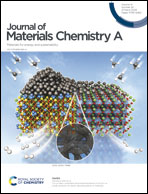
CuZn nanoalloy encapsulated within tannic acid-functionalized carbon nanotubes for efficient electrocatalytic urea synthesis
 *a
and
Guidong
Yang
*a
*a
and
Guidong
Yang
*a
Abstract
Electrocatalytic C–N coupling of carbon dioxide (CO2) and nitrate (NO3−) is regarded as an energy-efficient and sustainable strategy for urea production. However, this reaction involves multiple electron-transfer processes and complex intermediates. In particular, the CO2 reduction reaction (CO2RR) generally requires a higher overpotential than the nitrate reduction reaction (NtrRR), which severely hinders the formation of the target product. To address this challenge, we designed a CuZn nanoalloy encapsulated within carbon nanotubes (CNTs) and further coated with tannic acid (TA). The hydroxyl groups of TA establish noncovalent interactions with CO2, thereby enhancing its adsorption, while the synergistic effect between Cu and Zn inhibits the NtrRR and facilitates the co-reduction of CO2 and NO3−. As a result, the catalyst achieves a maximum urea yield of 887.48 µg mgcat.−1 h−1 with a faradaic efficiency of 47.2% at −0.8 V vs. RHE. Comprehensive product analysis coupled with in situ spectroscopic studies reveals that the cooperative interaction between Cu and Zn suppresses the over-reduction of NO3−, promotes the effective activation of CO2 and free water, and accelerates the coupling of *NH2 and *CO intermediates into *CONH2, thereby enabling efficient urea synthesis. This work highlights that CNT-encapsulated nanoalloy electrocatalysts provide valuable insights for the sustainable and efficient production of C–N compounds.

- This article is part of the themed collection: Advances in Sustainable Catalysis: from Materials to Energy and Environmental Applications
 Please wait while we load your content...


