


Multimaterial additive manufacturing of GelMA hydrogel-based structures with tuneable composition and mechanical properties
 b
Feiran
Wang,
a
Nathan
Carpentier,
b
Long
Jiang,
b
Felicity R. A. J.
Rose,
b
Ricky D.
Wildman
*a
and
Lyudmila
Turyanska
*a
b
Feiran
Wang,
a
Nathan
Carpentier,
b
Long
Jiang,
b
Felicity R. A. J.
Rose,
b
Ricky D.
Wildman
*a
and
Lyudmila
Turyanska
*a
Abstract
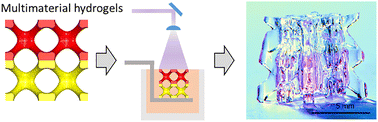
Multimaterial additive manufacturing is an emerging field that could underpin innovation across various industries, with multimaterial hydrogel structures being of particular interest for healthcare. Stereolithography-based processes offer high resolution and compatibility with materials, such as hydrogels. Here, we present a methodology to achieve high resolution multimaterial fabrication of GelMA- and PEG-based hydrogels using vat-photopolymerisation processes, including projection micro-stereolithography and two-photon polymerisation. By optimising resin formulations, printing strategies, and post-printing processes, we produce high-fidelity 3D multimaterial hydrogel structures with either defined material interfaces or compositional gradients, which provide a tool for controllable modification of their chemical composition, alongside tunable mechanical properties (in the range of 2–12 kPa). Using rhodamine B and acrylated rhodamine B, as exemplar guest molecules, we demonstrate reversible impregnation of hydrogels for sustained release and permanent formation of compositional gradients. These capabilities, combined with the inherent biocompatibility of hydrogels, are relevant for applications in drug delivery, wound healing, and environmental sensing, among others. As an illustration, we evaluate the performance of printed hydrogels as sensing layers on interdigitated devices for monitoring salt-rich environments. Together, these findings establish a versatile strategy for high-resolution multi-material hydrogel manufacturing, offering new opportunities for engineered bio-architectures, suitable for healthcare and environmental applications.
- This article is part of the themed collection: Materials Advances in Additive Manufacturing: from Processing to Applications
 Please wait while we load your content...


