


Enhancing butadiene yield and catalyst stability via aqueous feed dilution in 1,3-butanediol dehydration

Abstract
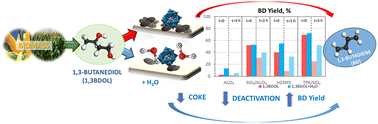
The influence of using water as a diluent on the catalytic performance and deactivation in the gas-phase reaction of 1,3-butanediol (1,3BDOL) at 523 K was studied on four solid acid catalysts: HZSM5, SiO2/Al2O3, Al2O3, and TPA (tungstophosphoric acid)/SiO2. Reactions were carried out using both pure 1,3BDOL and 1,3BDOL 10 wt% in water as reactants. Both fresh and spent catalysts were characterized using various techniques, including N2 physisorption, Fourier Transform Infrared (FTIR) spectroscopy, FTIR of adsorbed pyridine, MAS NMR, and Temperature Programmed Oxidation (TPO). The use of 1,3-butanediol diluted in water in the reaction increased butadiene selectivity over SiO2/Al2O3, HZSM5, and TPA/SiO2 while reducing coke formation, without altering the nature of the carbonaceous deposits, as confirmed by TPO and FTIR analyses. The reaction results showed that the presence of water is a key parameter in mitigating deactivation, enhancing the stability of catalytic activity during the conversion of 1,3BDOL on SiO2/Al2O3, HZSM5, and TPA/SiO2, as well as the selectivity towards butadiene.
- This article is part of the themed collection: Celebrating Latin American Chemistry
 Please wait while we load your content...


