


Single-atom catalyzed formation of inorganic-rich SEI/CEI for durable anode-free solid-state lithium metal batteries
 *ab
*ab
Abstract
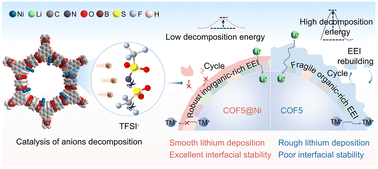
Anode-free solid-state lithium metal batteries are promising for energy storage owing to their maximum energy density, safety, and cost-effectiveness. However, their practical application remains hindered by fragile electrode–electrolyte interfaces (EEI) and the resulting rapid active-species depletion. Here, a single-atom catalysis strategy is proposed for the in situ construction of inorganic-rich EEI by utilizing a single-Ni-atom-anchored covalent organic framework (COF) as a catalyst, which is incorporated into a polymer electrolyte. The B–O–Ni bridge on COF-5 accelerates the electron transfer to the TFSI− anion and improves the decomposition kinetics of lithium salt, thereby building an inorganic-rich solid electrolyte interphase (SEI) to enable smooth Li deposition and remarkable interfacial stability. Additionally, the boron-based COF-5-generated B, F-rich cathode electrolyte interphase (CEI) inhibits the dissolution of transition metal ions and ensures the structural integrity of NCM cathodes upon cycling. Consequently, the NCM622||Li solid-state cell demonstrates an exceptional capacity retention of 92.0% over 1500 cycles at 1.0C while achieving a remarkable capacity of 172.4 mA h g−1 after 200 cycles at 0.2C, under a cutoff voltage of 4.7 V. Moreover, the anode-free NCM622||Cu solid-state pouch cell maintains stable cycling for over 200 cycles in the presence of carbonate electrolytes. This study extends single-atom catalysis into a platform to regulate lithium-salt decomposition for achieving prolonged anode-free solid-state batteries.
 Please wait while we load your content...


