


Solution-processed bulk heterojunction solar cells based on porphyrin small molecules with very low energy losses comparable to perovskite solar cells and high quantum efficiencies†
Abstract
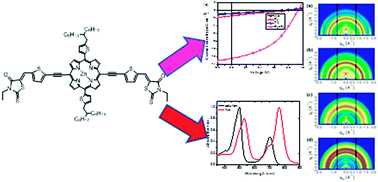
Two new A–D–A conjugated small molecules Por-Rod and Por-CNRod were developed using a porphyrin core as the donor unit and 3-ethylrhodanine and 2-(1,1-dicyanomethylene)rhodanine as the acceptor units. Por-Rod and Por-CNRod show broad absorptions up to ∼850 nm with optical energy bandgaps of 1.47 and 1.45 eV, respectively. Additionally, their blend films containing PC71BM show SCLC hole mobilities of 8.5 × 10⁻⁵ and 7.5 × 10⁻⁶ cm2 V−1 s−1, respectively. Although bulk heterojunction solar cells containing PC71BM that were processed either without additives, with thermal annealling alone or with only pyridine show very low power conversion efficiencies (PCEs), Por-Rod-based solar cells processed using pyridine and then thermal annealing, show a PCE of up to 4.97% with a remarkable VOC of up to 0.94 V and a very low energy loss of only 0.53 eV. This is the first report in which small molecule-based solar cells show such a low energy loss comparable to perovskite solar cells, while exhibiting a good PCE of about 5% and a maximum external quantum efficiency up to 61%. To further understand the effect of different processing conditions on the blend films, the morphology of the blend films was studied by grazing incidence X-ray diffraction and resonant soft X-ray scattering.
- This article is part of the themed collection: Small Molecules and Monodisperse Oligomers for Organic Electronics
 Please wait while we load your content...


