Yang Liu, Keying Long, Hanbing Mi, Ruitao Cha and Xingyu Jiang
Nanoscale Horiz., 2019,4, 953-959
DOI:
10.1039/C8NH00494C,
Communication


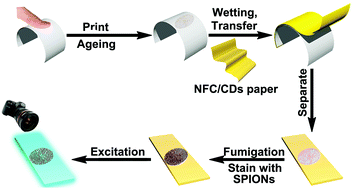
Fingerprint identification, initially developed as physical evidence for personal identification at crime scenes, has become extraordinarily useful in many fields, such as passwords for computers and smartphones, codes for security clearance and so forth. But the development of fingerprints is often plagued by the real environment and un-uniform nature of most substrates, which lead to the partial or complete absence of information. A particular bottleneck in these applications is latent fingerprint (LFP) visualization on rough surfaces. In this report, we developed a fluorescent nanofibrillated cellulose/carbon dot (NFC/CD) paper to address the high-efficiency transfer and detection of LFPs on different substrates simultaneously. We can transfer most of the feature points from rough surfaces onto the NFC/CD paper, whereas we can extract few feature points from a rubber substrate using cyanoacrylate fuming and staining with super-paramagnetic iron oxide nanoparticles. The NFC/CD paper has great potential in the fields of image analysis, packaging, smartphones, entrance clearance, personal identification, and mobile payments.