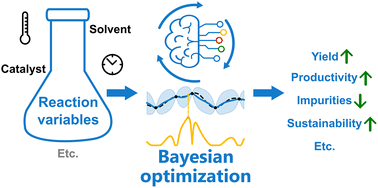
Bayesian optimization for chemical reactions

Abstract

Bayesian optimization (BO) enables data-efficient optimization of complex chemical reactions by balancing exploration and exploitation in large, mixed-variable parameter spaces. This review provides an accessible introduction for chemists wishing to adopt BO, outlining the fundamentals of surrogate models, acquisition functions, and key mathematical concepts. Practical considerations are emphasized, including kernel design, representation of categorical variables, and strategies for multi-objective and batch optimization. Applications are comprehensively surveyed across experimental scales, from high-throughput platforms to automated flow reactors and larger-scale processes. Finally, emerging directions such as transfer learning and data reuse are discussed in the context of accelerating optimization campaigns and enabling more generalizable, data-driven strategies in chemistry.

Graphical abstract: Bayesian optimization for chemical reactions

Transparent peer review

To support increased transparency, we offer authors the option to publish the peer review history alongside their article.

View this article’s peer review history

Article information

Article type
Review Article
Submitted
30 Sep 2025
First published
10 Feb 2026
This article is Open Access
Creative Commons BY-NC license

Chem. Soc. Rev., 2026, Advance Article

Bayesian optimization for chemical reactions

S. Desimpel, M. Dorbec, K. M. Van Geem and C. V. Stevens, Chem. Soc. Rev., 2026, Advance Article , DOI: 10.1039/D5CS00962F

This article is licensed under a Creative Commons Attribution-NonCommercial 3.0 Unported Licence. You can use material from this article in other publications, without requesting further permission from the RSC, provided that the correct acknowledgement is given and it is not used for commercial purposes.

To request permission to reproduce material from this article in a commercial publication, please go to the Copyright Clearance Center request page.

If you are an author contributing to an RSC publication, you do not need to request permission provided correct acknowledgement is given.

If you are the author of this article, you do not need to request permission to reproduce figures and diagrams provided correct acknowledgement is given. If you want to reproduce the whole article in a third-party commercial publication (excluding your thesis/dissertation for which permission is not required) please go to the Copyright Clearance Center request page.

Read more about how to correctly acknowledge RSC content.

Social activity

Spotlight

Advertisements