Anwesha Maiti, Saikat Kumar Manna, Dipanjan Banik and Ajit Kumar Mahapatra
New J. Chem., 2021,45, 20046-20074
DOI:
10.1039/D1NJ04056A,
Perspective


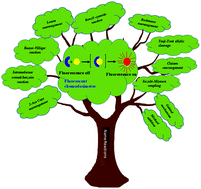
The design and synthesis of suitable chemodosimeters for the detection of toxic analytes has become challenging for new researchers nowadays in the molecular recognition field. Among different chemical reactions, name reaction-based approaches will help researchers to gain knowledge about different types of name reactions for different analytes, the mechanism of sensing using these reactions, the names of scientists who pioneered these name reactions, and also to explore unknown name reactions for unexplored analytes. In this context, we have reported different sensing strategies, i.e., name reaction-based approaches involved in designing various chemodosimeters during the past decades. The name reaction-based approaches have been classified into 11 types, such as (a) Tsuji–Trost allylic cleavage, (b) Suzuki–Miyaura coupling, (c) Claisen rearrangement, (d) benzil-cyanide reaction, (e) intramolecular crossed-benzoin reaction, (f) Michael addition reaction, (g) Gabriel mechanism, (h) 2-aza-Cope rearrangement, (i) Baeyer–Villiger reaction, (j) Beckmannn rearrangement, and (k) Lossen rearrangement. The focus of the review is mainly on how name reactions are used in analyte detection chemodosimetrically.