


The critical impact of electrolyte concentration on Al3+ redox and stability of CuHCF in aqueous aluminum-ion batteries

Abstract
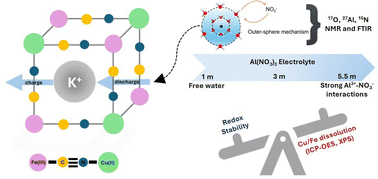
Aqueous aluminum-ion batteries (AIBs) are promising candidates for sustainable, high-energy-density storage. Despite this, their practical deployment is hindered by challenges in optimizing Al3+ redox activity and long-term stability. Here, we systematically investigate the impact of Al(NO3)3 electrolyte concentration (1–5.5 m, m: molal) on the electrochemical performance of copper hexacyanoferrate (CuHCF), a Prussian blue analogue (PBA) cathode. Electrochemical measurements reveal that a 5.5 m Al(NO3)3 electrolyte achieves the most stable cycling, with the lowest irreversible capacity loss (∼12%) in the initial cycle. Structural analyses using X-ray diffraction and X-ray photoelectron spectroscopy confirm that higher electrolyte concentrations (>3 m) enhance the stability of the CuHCF framework, exhibiting near-zero lattice strain during Al3+ insertion. Spectroscopic studies (FTIR and multinuclear NMR) reveal a concentration-dependent shift in hydration structure, from free water to tightly bound Al3+–NO3− contact ion pairs, which effectively suppresses parasitic reactions by reducing free water activity. However, inductively coupled plasma optical emission spectroscopy reveals a trade-off: while 5.5 m Al(NO3)3 maximizes redox activity, it also accelerates Cu and Fe dissolution (∼40% Cu loss after 200 cycles). These findings highlight the necessity of balancing electrolyte concentration to optimize both stability and capacity retention, identifying a range of 3–5.5 m Al(NO3)3 as the optimal range for mitigating degradation while maintaining robust electrochemical performance in aqueous AIBs.
- This article is part of the themed collection: Advanced aqueous batteries
 Please wait while we load your content...


