


Size-controlled CuO nanoparticles in KIT-6: magneto-photocatalytic properties and mechanistic insights
 ab
Anindita
Sarkar,
d
Ahin
Roy,
d
Debasis
Sen,
bc
Kaustava
Bhattacharyya
*ab
and
Avesh Kumar
Tyagi
*b
ab
Anindita
Sarkar,
d
Ahin
Roy,
d
Debasis
Sen,
bc
Kaustava
Bhattacharyya
*ab
and
Avesh Kumar
Tyagi
*b
Abstract
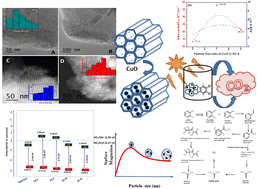
Size-dependent alterations in material properties, particularly changes in photocatalytic and magnetic behavior, have consistently attracted significant scientific interest. CuO nanoparticles were dispersed in mesoporous KIT-6 using the wet impregnation technique and the differences in the amount of CuO loadings led to alteration in the particle size with very narrow distribution. These materials were characterized using different techniques such as Small-Angle X-ray Scattering (SAXS), X-Ray Diffraction (XRD), X-ray Photoelectron Spectroscopy (XPS), High-Resolution Transmission Electron Microscopy (HR-TEM), Scanning Transmission Electron Microscopy (STEM), EELS mapping, EPR, etc. The SAXS study confirmed the presence of a three-dimensional cylindrical pore system in the synthesized KIT-6. These pores were filled without affecting the pore size or pore ordering with increasing CuO dispersion present as clusters within the channels of the mesoporous material. The magnetic properties along with the photocatalytic properties of CuO-KIT-6 (CK) were understood as a function of the particle size. The photocatalytic studies for the degradation of ortho-dichlorobenzene (o-DCB) showed these CKs to be good photocatalysts showing partial o-DCB degradation. The mechanism for the degradation of the o-DCB solution as a function of particle size is postulated in light of variation of magneto-photocatalytic properties.
- This article is part of the themed collection: The Changing Canvas of Nano
 Please wait while we load your content...


