


A palladium bio-nanocomposite as an efficient heterogeneous catalyst for nitro reduction: a fungus mediated green and sustainable process

Abstract
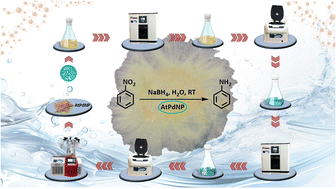
Metallic nanocatalysts such as palladium nanoparticles (Pd-NPs) possess remarkable catalytic activity owing to their high surface-to-volume ratio; however, aggregation and metal leaching significantly compromise their stability and practical applicability. In this work, we report a facile and sustainable biosynthetic route for the preparation of bio-stabilized Pd-NPs using the fungal strain Aspergillus trinidadensis VM ST01 (OL587588) as a green reducing and capping agent. The strategy enables simultaneous bio-reduction of Pd2+ ions, nucleation and in situ surface functionalization without the use of hazardous chemicals, surfactants, buffer, or external stabilizers. The influence of culture age (24–54 h), biomass loading (0.08–0.24 g mL−1), and incubation time (8–24 h) on NP formation was systematically investigated to achieve controlled synthesis. Comprehensive physicochemical characterization (UV-vis, FT-IR, XRD, SEM, TEM, elemental mapping, EDX, XPS, and TGA) confirmed the formation of uniformly distributed Pd-NPs with an average size of ∼35 nm, embedded and stabilized within the fungal biomass matrix. The bio-organic framework surrounding the nanoparticles effectively suppresses aggregation and minimizes palladium leaching, thereby enhancing catalyst durability. The catalytic performance of the biosynthesized AtPdNPs was evaluated for the hydrogenation of nitro-benzene (NB) to amino-benzene (AB) as a model reaction under mild and aqueous conditions (NaBH4, ambient temperature and ambient pressure). The optimized catalyst (0.16 g mL−1 biomass, 36 h of culture age, and 24 h of incubation) achieved complete conversion within 30 min, delivering a turnover frequency (TOF) of 832 h−1 and a turnover number (TON) of 416. The kinetics for the reduction of NB to AB was investigated, and the catalytic activity of AtPdNPs was evaluated as the pseudo-first-order rate constant (kapp). The in situ bio-coating of AtPdNPs significantly reduces palladium leaching (<1.5% ppm), enhances storage stability and makes it an environmentally compatible material. As a result, the catalyst maintains its structural integrity and catalytic performance under industry relevant conditions.
- This article is part of the themed collection: Photocatalytic Materials for Clean Energy, Renewable Chemicals production, and Sustainable Catalysis
 Please wait while we load your content...


