


 PLATFORM UPDATE:


Are regium bonds directional?†
 a
and
Binoy K.
Saha
*a
a
and
Binoy K.
Saha
*a
Abstract
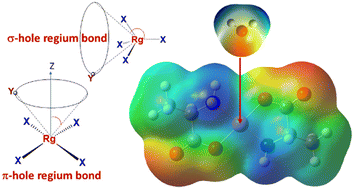
Cu is an essential element in biological systems, and Ag and Au are used in biomedical applications. Therefore, interactions of these species with other electron-rich species play crucial roles in our biological systems. These types of interactions, involving the group 11 elements, are known as regium bonds. These bonds also play important roles in some catalytic reactions. Here, the preferred geometries of the regium bonds between the tetrahedral and square-planar RgX4 (Rg = Cu, Ag, and Au; X can be any atom) complexes and electron-rich species (Y), such as O and N, are evaluated through geometry-corrected statistical analyses. The tetrahedral complexes exhibit a preference for linear geometry (∠X–Rg⋯Y = ∼180°, Y = N or O), which is observed for typical σ-hole interactions, and for the square planar RgX4 complexes, the preferred ∠Z–Rg⋯Y angle is ∼0° (Z is an arbitrary point, such that Z–Rg is normal to the RgX4 plane), which is expected from a typical π-hole interaction. Distance-cone corrected statistical analyses suggest that the preferred Cu⋯N and Cu⋯O distances are longer than the Cu–N and Cu–O coordination bonds but shorter than the sum of the van der Waals radii of the interacting atoms in the square-planar X4Cu⋯Y complexes. DFT calculations on two structures suggest that the interaction energies of X4Cu⋯N and X4Cu⋯O regium bonds in two crystal structures are from −8 to −9 kcal mol−1. QTAIM analyses show the presence of bond paths and critical points between the interacting atoms, and apart from the electrostatic contributions suggested by the MEP analyses, NBO analyses reveal donor-acceptor types of π-hole interactions between the lone pair of N or O and the LP* of Cu.
- This article is part of the themed collection: Celebration of the 70th birthday of Prof. Giuseppe Resnati
 Please wait while we load your content...


