


Structure of iridium oxide catalysts dictates performance differences for proton exchange membrane water electrolyzers
 a
Juhyun
Oh,
f
Shannon W.
Boettcher,
h
Ethan J.
Crumlin,
de
Michael J.
Zachman,
f
Iryna V.
Zenyuk
*ab
a
Juhyun
Oh,
f
Shannon W.
Boettcher,
h
Ethan J.
Crumlin,
de
Michael J.
Zachman,
f
Iryna V.
Zenyuk
*ab
Abstract
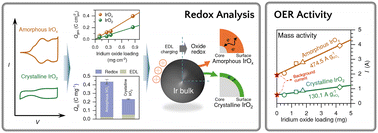
Proton exchange membrane water electrolyzers (PEMWEs) are promising zero-emission technologies. However, their high cost remains a barrier to widespread adoption. Iridium oxide is commonly used as an oxygen evolution reaction (OER) catalyst, and its cost and scarcity make it essential to reduce its loading while increasing its activity. Evaluation of iridium oxide activity should be carried out in the membrane electrode assembly (MEA) configuration to replicate realistic operating conditions. Herein, we present a comprehensive benchmarking framework to accurately evaluate the amorphous and crystalline iridium oxides at the MEA level. By systematically varying the catalyst loading, this study confirmed that each MEA was utilized uniformly, presenting intrinsic electrochemical properties independent of the loading. Through intrinsic charge density determined by voltammetry, we established two electrochemical descriptors to evaluate catalyst redox reactions. The mass activity was evaluated by correlating current vs. loading, and the slope provides loading-independent mass activity. The effect of the porous transport layer on OER activity was discussed, identifying a ‘background’ current at zero-loading. This study highlights potential pitfalls in MEA-level catalyst screening and underscores the importance of the loading study for reliable results.
 Please wait while we load your content...


