


Recent advances in polymeric materials for direct carbon dioxide capture from ambient air

Abstract
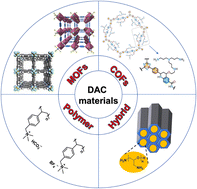
The continuous rise in the atmospheric carbon dioxide (CO2) concentration has led to increasingly severe climate problems. Direct air capture (DAC) technology is regarded as a promising “negative emission” approach, which has been attracting considerable attention in recent years. The design of DAC materials that combine high efficiency, long-term stability, and economic feasibility has become a major challenge. This review highlights the recent advances in the synthesis and CO2 capture performance of polymer-based DAC systems, with particular emphasis on functional polymers, polymer composites, metal–organic frameworks (MOFs) and covalent organic frameworks (COFs). By summarizing key synthetic strategies and structure–property relationships, this article aims to provide theoretical guidance and technical references for the development of next-generation high-performance carbon capture materials while outlining emerging opportunities for DAC material innovation.
- This article is part of the themed collections: Journal of Materials Chemistry A Recent Review Articles and Celebrating 30 years of materials science and engineering at South China University of Technology
 Please wait while we load your content...


