


Highly stable linking of platinum and porous spinel via carbon bridge engineering towards a long-lifespan rechargeable zinc–air battery

Abstract
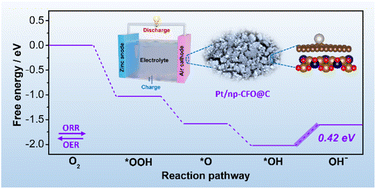
The development of bifunctional oxygen electrocatalysts is crucial for the commercialization of rechargeable zinc–air batteries (RZABs). This work proposes an innovative strategy of “dealloying–carbon coating–dip pyrolysis” for the highly stable anchoring of a small amount of Pt nanoparticles (0.032 mg cm−2) onto carbon-encapsulated nanoporous CoFe2O4 (np-CFO). Benefiting from its nanoporous structure with a larger specific surface area and adhered carbon layer with superior electrical conductivity, the sandwich-like Pt/np-CFO@C electrode exhibits a lower OER–ORR potential gap (ΔE) of 0.7 V. Meanwhile, a Pt/np-CFO@C-based RZAB delivers a specific capacity of 781 mA h g−1, power density of 185 mW cm−2 and cycling life exceeding 1400 hours. FTIR and XAFS results indicate that the carbon layer could not only play a bridging role between np-CFO and Pt, but also lead to the loading of more zero-valent Pt. HAADF imaging proves that the post-formed oxide layer can protect Pt from inactivation through strong metal–support interaction (SMSI). In situ Raman and RRDE testing confirm the 4-electron transfer mechanism of the ORR on Pt/np-CFO@C. DFT calculations verify that Pt/CFO@C has metallic properties, symmetric d-band centers and the lowest energy barrier for the ORR/OER. In situ XRD reveals that the size of Pt nanoparticles could become smaller in the early stage of discharge, which is beneficial for exposing more active sites and showing gradually improving performance. This study lays the groundwork for the future development of cost-effective RZABs.
- This article is part of the themed collection: 2026 Chemical Science HOT Article Collection
 Please wait while we load your content...


