


Unveiling structural forms of Ru in WOx-template catalysts for efficient acidic PEM water electrolysis

Abstract
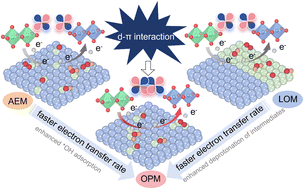
In acidic systems, elucidating the structural forms and mechanisms of Ru that achieve high activity and stability upon combination with oxides offers valuable insights for designing efficient and durable PEM water electrolysis catalysts. In this study, different Ru forms, including single atoms, sub-nanometric clusters, and heterostructures, were strategically introduced into a WOx template to systematically investigate their effects on OER performance. In situ characterization techniques (ATR-SEIRAS, DEMS, and in situ Raman) combined with theoretical calculations reveal that the d–π interactions within the continuously coupled orbitals introduced by subnanometer Ru clusters accelerate electronic delocalization, thereby optimizing the interfacial water structure and hydrogen-bond network and enhancing *OH adsorption. Meanwhile, this interaction facilitates the deprotonation of intermediates, maintains a high surface coverage of *O species, and modulates the post-adsorption electronic structure, which collectively promote *O–*O coupling and the Oxide Path Mechanism (OPM) pathway, endowing the catalyst with superior activity and stability. The resulting RuSNCs-WOx exhibits outstanding acidic OER performance, achieving 10 mA cm−2 at only 171 mV overpotential and retaining excellent stability over 1000 hours. In PEM electrolyzer tests, it outperforms conventional RuO2, sustaining 1 A cm−2 operation for over 1000 hours.
- This article is part of the themed collection: 2026 Chemical Science HOT Article Collection
 Please wait while we load your content...


