


Natural monosaccharide-based piezoelectric supramolecular materials for energy harvesting and information transmission
 *a
*a
Abstract
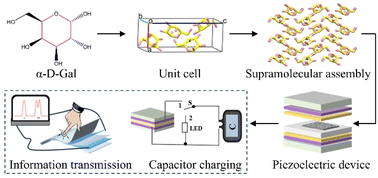
Biomolecular assemblies with non-centrosymmetric structures exhibit a piezoelectric response that can be applied to bionanotechnology. However, the piezoelectricity of monosaccharide self-assembled materials has not been previously reported. Herein, for the first time, we systematically investigated the piezoelectric properties of fourteen natural monosaccharide-based supramolecular materials, aiming to use them for energy harvesting and information transmission. The supramolecular arrangements and piezoelectricity responses of monosaccharide assemblies are predominantly governed by hydroxyl number and orientation. Density functional theory (DFT) calculations revealed that the maximum piezoelectric coefficients of monosaccharide assemblies ranged from 6 to 13.7 pC/N, in which α-D-Gal assemblies exhibited a higher value. The α-D-Gal assembly-based piezoelectric device generated an open-circuit voltage of 1.08 V under a 55 N mechanical load, enough to power an LED by charging a 0.1 µF capacitor for 1 minute, and produced 32 V across the capacitor after 4 minutes of charging. An α-D-Gal assembly-based composite film was used to generate signals that represented Morse code for information transmission, enabling the conversion of electrical signals into numbers, letters, and words. We report the piezoelectric properties of various monosaccharide self-assemblies and investigate the correlation between supramolecular structure and piezoelectric response, and also provide new ideas for the development of innovative green energy biomaterials and electronic information transmission media.
- This article is part of the themed collection: 2026 Chemical Science HOT Article Collection
 Please wait while we load your content...


