


Electroanalytical overview: recent advances in the sensing of arsenic using screen-printed electrochemical platforms

Abstract
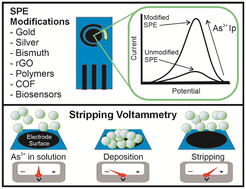
Access to clean drinking water remains a critical global health issue, with over 2 billion people lacking access to safely managed water. Among the contaminants of concern, heavy metals (particularly arsenic) pose significant risks due to their persistence and toxicity. Long-term exposure to arsenic (As3+), especially at concentrations exceeding the World Health Organisation's (WHO) guideline of 10 μg L−1, has been linked to severe health conditions, including cancer, dermatological issues, and cognitive impairments. Traditional laboratory-based approaches offer high sensitivity and selectivity but are expensive, time-consuming, and require skilled personnel, making them impractical for in-the-field use. In recent years, electrochemical methods, particularly using screen-printed electrodes (SPEs), have emerged as a promising alternative for As3+ detection, the most toxic form. SPEs offer a compact, cost-effective, and portable solution, enabling real-time, on-site monitoring of arsenic levels in water. This review systematically explores recent advancements in SPEs for the detection of As3+, with a focus on electrode modifications aimed at enhancing sensitivity and selectivity. We highlight techniques involving the integration of precious metals, biosensors, and carbon-based materials, all of which contribute to improved (lower) detection limits and wide sensing ranges. Practical applications in environmental monitoring (particularly in remote or resource-limited settings) are also discussed, offering a scalable and efficient solution for arsenic detection; SPEs have the potential to revolutionise water quality assessment and supporting global public health initiatives.
- This article is part of the themed collections: HOT articles from Environmental Science: Nano, Environmental Science: Nano Recent Review Articles and Recent Open Access Articles - Environmental Science: Nano
 Please wait while we load your content...


