


 PLATFORM UPDATE:


Development of visible-to-NIR light absorbing and emitting polymers incorporating hypervalent germafluorene-fused π-conjugated systems
 ab
Kazuo
Tanaka
*ab
ab
Kazuo
Tanaka
*ab
Abstract
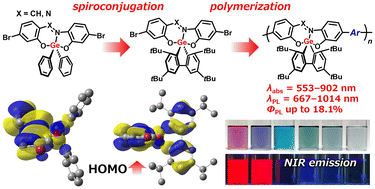
Novel molecular designs for creating near-infrared (NIR) light absorbing and emitting materials are required to meet the growing demand for NIR light-based technologies. Herein, we demonstrate that the five-coordinate hypervalent germanium (Ge) compounds composed of germafluorene-fused azomethine and azo scaffolds exhibit efficient light absorption and emission in the visible-to-NIR region (λabs = 505–902 nm, λPL = 667–1014 nm, and ΦPL up to 18.1%). These excellent optical properties are attributed to the hypervalent Ge-centered spiroconjugation and their planar π-conjugated systems. Experimental and theoretical data indicate that spiroconjugation plays a significant role in the elevation of the HOMO (highest occupied molecular orbital) energy level. Moreover, the introduction of bulky substituents at the germafluorene moiety contributes to enhancing the planarity of the π-conjugated systems, which further narrows their energy gaps. Since the bulky substituents not only improved processability but also suppressed intermolecular interactions, efficient NIR emission was also observed in polymer films. These results suggest that the integration of hypervalent states with π-conjugated systems can be one of the effective strategies for tuning the electronic properties of NIR light absorbing and emitting materials.
- This article is part of the themed collection: Journal of Materials Chemistry C Emerging Investigators 2026
 Please wait while we load your content...


