


Boosting piezocatalytic hydrogen production via bismuth vacancy-engineered BiOCl–Bi2S3 heterojunctions fabricated by a light-induced deposition strategy
 *ab
*ab
Abstract
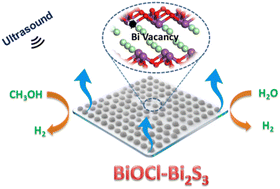
This study presents a novel light-induced deposition strategy for constructing BiOCl–Bi2S3 heterojunctions enriched with bismuth vacancies (VBi) to enhance piezocatalytic hydrogen evolution. The heterojunction was synthesized by photodepositing Bi2S3 onto BiOCl nanosheets with exposed (001) facets. Structural characterization confirmed the formation of the heterojunction and revealed that the reaction between Bi3+ in BiOCl and S2− generated VBi defects, leading to a dramatic enhancement of the piezoelectric coefficient (387 pm V−1vs. 151 pm V−1 for pristine BiOCl). The optimal composite (BiOCl–Bi2S3-40) achieved an obviously enhanced hydrogen production rate of 678.67 µmol g−1 h−1 in pure water under ultrasonic vibration (45 kHz, 120 W), double that of pristine BiOCl (352.53 µmol g−1 h−1). In methanol solution, the rate further surged to 2717.33 µmol g−1 h−1, which is higher than those of the previously reported piezocatalysts. The catalyst retained high stability over five cycles. Mechanistic studies attribute the enhanced performance to the strong built-in electric field from piezoelectric polarization, which promotes charge separation. VBi act as electron traps, reducing interfacial charge-transfer barriers. Synergy between the heterojunction and VBi facilitates efficient carrier migration. This work not only demonstrates a high-efficiency piezocatalyst but also provides insights into the critical role of cationic vacancies in piezocatalysis.
- This article is part of the themed collection: Advances in Sustainable Catalysis: from Materials to Energy and Environmental Applications
 Please wait while we load your content...


