


 PLATFORM UPDATE:


Design of a site selective heterochromic bimetallic lanthanide coiled coil with nanometre-scale control
 d
Nikolas J.
Brooks,
e
Robert I.
Hunter,
b
Hassane E. L.
Mkami,
b
Graham M.
Smith,
b
Aneika C.
Leney,
e
Niklaas J.
Buurma,
f
Janet E.
Lovett
bc
and
Anna F. A.
Peacock
*a
d
Nikolas J.
Brooks,
e
Robert I.
Hunter,
b
Hassane E. L.
Mkami,
b
Graham M.
Smith,
b
Aneika C.
Leney,
e
Niklaas J.
Buurma,
f
Janet E.
Lovett
bc
and
Anna F. A.
Peacock
*a
Abstract
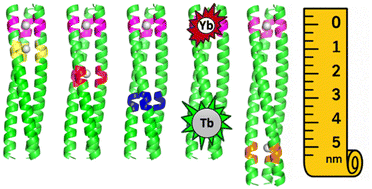
Lanthanide-protein scaffolds hold significant promise for the design of functional biomaterials. Yet the selective incorporation of multiple lanthanide ions with distinct properties into discrete sites at tuneable distances within a single construct remains a key challenge. Here, we report the rational design and structural characterization of the first de novo coiled coil capable of binding two different lanthanide ions at independent, non-equivalent sites with defined intermetallic spacing. By installing orthogonal coordination environments, comprising Asn3Asp3 and Asp3-only motifs, at defined positions along the coiled coil axis, we achieve precise, site-specific metal binding across a series of constructs spanning 1 to 5 nm. Site occupancy and intermetallic distances were validated using luminescence, electron paramagnetic resonance (EPR) spectroscopy, mass spectrometry and X-ray crystallography. The latter reveals the first structure of a coiled coil bound to two Tb3+ ions, and the shortest non-bridged metal–metal distance reported to date in such a scaffold (11.9 Å). The chemically distinct coordination sites enable sequential and selective metal loading. Remarkably, this system is capable of binding two different lanthanides, Tb3+ and Yb3+, at distinct sites, despite their extremely similar coordination chemistries. These results establish a robust and modular platform for constructing nanometre-scale molecular rulers, and highlight new avenues for the rational design of multifunctional metalloproteins.
- This article is part of the themed collection: 2026 Chemical Science HOT Article Collection
 Please wait while we load your content...


