


 PLATFORM UPDATE:


Artificial intelligence-assisted phenotyping of drug-resistant bacteria using a monosaccharide-based fluorescent sensor array
 *fg
Xiao-Peng
He
*ab
*fg
Xiao-Peng
He
*ab
Abstract
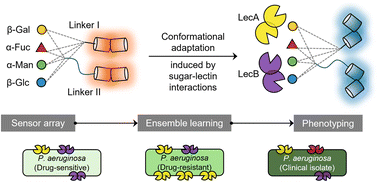
Chemical tools capable of effectively phenotyping drug-resistant bacteria can help improve therapeutic efficacy toward bacterial infections. While conventional techniques rely on labor-intensive procedures for the determination of bacterial susceptibility to antibiotics, here we developed a sensor array based on fluorogen-labelled monosaccharides to accurately phenotype drug-resistant bacteria with the assistance of artificial intelligence (AI). D-Glucose, D-galactose, L-fucose and D-mannose, which are common monomeric building blocks of natural glycans, were labelled with a “conformationally-adaptive” fluorophore (DPAC) with two different linkers, giving rise to a sensor array that consists of eight fluorescent glycoprobes. Using homogeneous high-throughput screening, we found that all the glycoprobes exhibited sensitive ratiometric fluorescence changes in the presence of Pseudomonas aeruginosa (P. aeruginosa) expressing bacterial lectins (LecA and LecB) selective for D-galactose, L-fucose and D-mannose. However, minimal fluorescence changes were seen when the glycoprobes were incubated with other bacterial strains lacking lectin expression. The use of ensemble learning to process the acquired sensing signals further enabled the accurate discrimination of clinically isolated, drug-resistant P. aeruginosa from drug-sensitive strains. Interestingly, using AI-assisted array sensing, we also achieved the phenotyping of P. aeruginosa after long-term exposure to mechanistically different antibiotics, thus highlighting the effectiveness of this approach for precision medicine.
- This article is part of the themed collection: 2026 Chemical Science HOT Article Collection
 Please wait while we load your content...


