


Revealing the kinetic limits of sodiation and lithiation at hard carbon using the diluted electrode method

Abstract
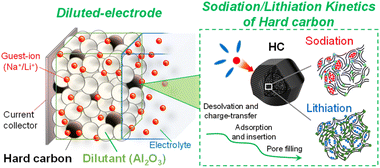
Electrochemical sodium and lithium insertion into hard carbon (HC) relies on two main reactions: adsorption/intercalation and pore-filling. The rates of these two reactions are key to attaining high power densities and fast charging in batteries, but distinguishing the rate limitations can be challenging due to their overlap and issues with Na+ and Li+ transport in conventional composite electrodes. Herein, we focus on the usage of the diluted electrode method to better evaluate the kinetics of electrochemical sodiation and lithiation in HC. Through galvanostatic charge/discharge testing, cyclic voltammetry and potential step analysis performed on diluted HC-electrodes in aprotic Na- and Li-cells, we confirm that the sodium-insertion rate into HC is faster than the lithium-insertion rate when we consider both adsorption/intercalation and pore-filling reactions. The apparent ion diffusion coefficients, Dapp, are on the order of 10−10–10−11 and 10−10–10−12 cm2 s−1 for sodium and lithium insertion, respectively. Furthermore, sodiation into the diluted HC-electrode showed comparable rate capability and Dapp to lithium intercalation at diluted graphite electrodes. In addition, we evaluated the temperature dependence using potential-step and electrochemical impedance methods, finding that activation energies, Ea, were ∼55 and ∼65 kJ mol−1 for sodiation and lithiation, respectively. We find reactions in the solid state, i.e., nucleation of pseudo-metallic clusters, as well as the charge transfer at the electrolyte/HC interface can limit the rate performance in diluted HC electrodes.
- This article is part of the themed collections: 2025 Chemical Science HOT Article Collection and 2025 ChemSci Pick of the Week Collection
 Please wait while we load your content...


