


Metallacycle- and metallacage-based supramolecular polymers: synthesis, characterization, and applications

Abstract
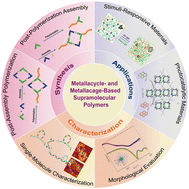
Metallacycle- and metallacage-based supramolecular polymers, which integrate well-defined coordination complexes with polymer chains, represent an emerging frontier in functional materials. This review summarizes recent progress in their synthesis, structural characterization, and potential applications. We discuss strategies for incorporating metallacycles or metallacages as core motifs, building blocks or crosslinking junctions within polymer architectures, illustrated through representative examples. Advanced analytical techniques that reveal hierarchical organization are highlighted, including scanning tunneling microscopy for single-molecule imaging and small-angle X-ray and neutron scattering for mesoscale morphological analysis. The combination of dynamic reversibility and precise geometric configuration in metallacycles and metallacages, alongside the mechanical robustness and processability of polymers, enables supramolecular polymers to function in stimuli-responsive systems, biomedical materials, molecular separation, and photocatalysis. Remaining challenges and future opportunities are outlined, providing a conceptual blueprint for researchers interested in this rapidly advancing field.
- This article is part of the themed collection: Pioneering Investigators 2025
 Please wait while we load your content...


