


Photocatalytic upcycling of captured carbon dioxide: current research progress and future directions

Abstract
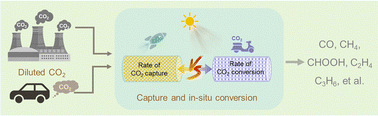
The development of efficient CO2 capture technology coupled with its photocatalytic conversion into high-value chemicals represents a promising pathway to address environmental and energy challenges while advancing global carbon neutrality. Recently, integrated strategies coupling CO2 capture with in situ photocatalytic conversion have attracted widespread research interest due to their potential to bypass energy-intensive steps such as CO2 desorption, purification, and compression, leading to significant progress in this field. This review systematically summarizes advances in such coupled systems, focusing on three key aspects: first, it evaluates CO2 capture media (e.g., amine-based solid adsorbents, porous materials, MOFs etc.) compatible with photocatalytic processes and analyzes the synergy between capture mechanisms and photo-reduction. Furthermore, it addresses the long-overlooked issue of kinetic mismatch between capture and conversion, elucidating its impact on reaction pathways and system performance. Finally, this review proposes a paradigm shift from spatial coupling to temporal regulation and discusses remaining challenges and potential solutions. By synthesizing recent developments and identifying future directions, this review aims to provide a theoretical foundation and design principles for building efficient and stable integrated CO2 capture-photocatalysis systems, thereby accelerating their practical application and industrial adoption.
- This article is part of the themed collection: ChemComm Nanocatalysis
 Please wait while we load your content...


