


Synergy and interface: design of MXene/LDH composites and their electrochemical energy storage applications
 *ab
*ab
Abstract
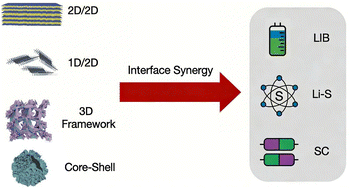
The development of high-performance electrode materials is crucial for advancing electrochemical energy storage. MXene (two-dimensional layered transition metal carbides or nitrides)/layered double hydroxide (LDH) composites are highly promising, synergistically combining MXene's conductivity with LDH's high capacity. This review summarizes recent progress in these composites, outlining their intrinsic properties and synergistic mechanisms. It analyzes diverse structural designs—from 2D/2D and 1D/2D heterostructures to 3D frameworks and core–shell architectures—and their effects on electron/ion transport and stability. Subsequently, their performance and mechanisms in critical systems such as lithium-ion batteries, lithium–sulfur batteries, and supercapacitors were discussed, focusing on representative quantifiable indicators. In lithium-ion batteries, MXene/LDH composites exhibit significantly enhanced reversible capacity and cycling stability. For lithium–sulfur batteries, they show significantly improved rate capability and long-term cycling performance. In supercapacitors, the energy density of these composites is significantly increased, outperforming traditional electrode materials. Finally, challenges and future directions are discussed, emphasizing the need for advanced interface engineering and exploration in emerging storage technologies to guide the design of high-performance electrodes.
- This article is part of the themed collection: 2026 PCCP Reviews
 Please wait while we load your content...


