


Supramolecular assembly of an organoplatinum(ii) complex boosts intersystem crossing for potentiated photocatalytic therapy and disulfidptosis
 *b
and
Pingyu
Zhang
*a
*b
and
Pingyu
Zhang
*a
Abstract
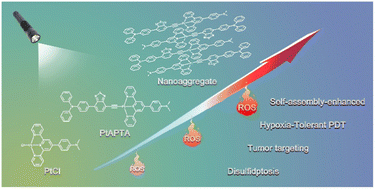
The supramolecular assembly of platinum(II) terpyridine complexes, driven by noncovalent Pt(II)⋯Pt(II) metallophilic interactions and π–π stacking, has been demonstrated to exhibit significant potential for advanced applications. In this study, we present PtATPA, an organoplatinum(II) complex with an electron-donor–acceptor structure that self-assembles into nanostructures through Pt⋯Pt and π–π interactions, exhibiting enhanced photophysical properties for improved photocatalytic therapy (PCT). The assembly induces a significantly improved singlet–triplet intersystem crossing, thereby amplifying the PCT effect. Upon white light irradiation, the PtATPA complex not only generates a substantial amount of reactive oxygen species (ROS) but also photocatalyzes the oxidation of nicotinamide adenine dinucleotide phosphate (NADPH)—an essential coenzyme. In A549 cells, PtATPA-induced oxidative stress downregulates GLUT1 to disrupt glucose metabolism, leading to NADPH depletion, disulfide stress, F-actin cytoskeleton collapse, and ultimately disulfidptosis. This study provides a promising strategy for leveraging self-assembled metal complexes to improve PCT and induce tumor-specific disulfidptosis, offering new insights into future cancer therapy.
- This article is part of the themed collection: 2025 Inorganic Chemistry Frontiers HOT articles
 Please wait while we load your content...


