


Effect of severe plastic deformation on thermoelectric properties of BiCuSeO

Abstract
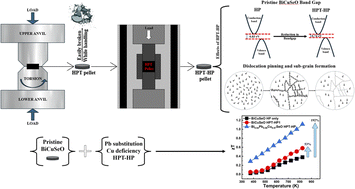
Severe plastic deformation processes are an excellent way to attain grain refinements and introduce dislocations in the material without compromising on the sample dimensions. High-pressure torsion (HPT) is a prime example of a severe plastic deformation process. In this work, HPT processing is employed to introduce a dense network of dislocation structures in BiCuSeO, which is a layered material known for its promising thermoelectric properties. Two categories of samples were prepared. The first category is the hot-pressed sample (HP) and the second category is the HPT-processed and subsequently hot-pressed samples (HPT-HP). The pristine HPT-HP1 sample shows a reduced bandgap of 0.74 eV compared to the pristine HP sample with a bandgap of 0.83 eV due to the combined effect of shear strain and pressure from the HPT process. This reduction in bandgap contributes to the increase in electrical conductivity from 17 S cm−1 in the pristine HP sample to 25 S cm−1 in the pristine HPT-HP1 sample at 823 K. The HPT-HP1 sample preparation conditions were then chosen to prepare a Cu-deficient Pb-substituted set of samples. The shear deformation from the HPT creates increased levels of dislocation density of about 5.02 × 10¹⁶ m−2 in the HPT-HP Bi0.94Pb0.06Cu0.97SeO sample compared to its HP counterpart (2.53 × 10¹⁴ m−2). These dislocations along with their corresponding lattice strains lead to a lattice part of thermal conductivity of 0.37 W m−1 K−1 at 823 K. Additionally, the reduced bandgap effect leads to an electrical conductivity of 145.5 S cm−1 in the HPT-HP Bi0.94Pb0.06Cu0.97SeO sample, resulting in a zT of 1.11 at 823 K.
- This article is part of the themed collection: Thermoelectric energy conversion
 Please wait while we load your content...


