


Carbohydrate-powered solar cells: how starches give perovskite extra energy
 a
Rico
Meitzner,
b
Yuxin
Liu,
c
Nopporn
Rujisamphan,
d
Eva
Unger
bc
and
Rongrong
Cheacharoen
*ae
a
Rico
Meitzner,
b
Yuxin
Liu,
c
Nopporn
Rujisamphan,
d
Eva
Unger
bc
and
Rongrong
Cheacharoen
*ae
Abstract
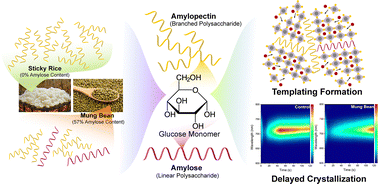
Perovskite solar cells (PSCs) have emerged as promising low-cost photovoltaics, combining high efficiency with solution-processable and scalable fabrication. Realizing stable PSCs via ambient-condition processing is critical for practical, large-area manufacturing. Natural additives offer a sustainable means to direct perovskite crystallization and improve film quality; however, the relationship between their molecular structure and perovskite nucleation, defect passivation, and stability—especially under high-humidity conditions—remains underexplored. Here, we systematically investigate the impact of starch structures, focusing on the ratio of linear amylose to branched amylopectin, on perovskite formation at 50% relative humidity. We demonstrate that amylose-rich starch templates the growth of highly oriented, compact perovskite films with significantly suppressed defect densities. This molecular templating enhances the optoelectronic quality of the perovskite absorber, resulting in a 15% improvement in the power conversion efficiency of all-solution-processed carbon-based PSCs. Moreover, devices incorporating amylose exhibit markedly improved operational stability, with suppressed burn-in and a doubled T80 lifetime under ISOS-L-1 testing. These results reveal the crucial role of natural polymer structures in modulating crystallization pathways and defect chemistry under real-world conditions. Our findings establish a design principle for sustainable, ambient condition-processable PSC fabrication and provide a blueprint for eco-friendly additive engineering in hybrid optoelectronic materials.
- This article is part of the themed collection: Materials Chemistry Frontiers Emerging Investigator Series 2024–2025
 Please wait while we load your content...


