



Hydrogenation of ethylene over molybdenum–sulfur complexes supported on UiO-66

Abstract
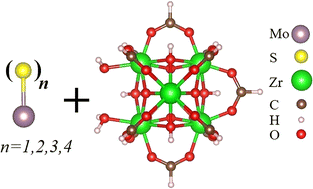
Development of supported single-site catalysts using small metal sulfide complexes could significantly help in the development of cost-effective catalytic materials to drive selective hydrogenation and hydrogenolysis. The goal of this study is to contribute to the development of metal sulfide catalysts by calculating the thermodynamics of a catalytic cyclic involving a metal organic framework functionalized by insertion of metal sulfide. Anchored metal sulfide complexes can potentially be designed with ligands with distinctly different electronic and catalytic properties for specific catalytic applications. Here we examine the hydrogenation of ethylene as a model. We use density functional theory to investigate molybdenum–sulfur complexes as active catalysts anchored on the metal–organic framework UiO-66 as a stable support. Our calculations show that the anchored complexes with more than two sulfur ligands are unfavorable for ethylene adsorption, so we study complexes with one or two sulfur ligands. Hydrogenation of the unsaturated carbon double bond requires the transfer of two hydrogen atoms, which can occur via heterolytic activation of hydrogen to form a Mo-hydride and a protonated sulfur – either by hydride transfer followed by proton transfer or via proton transfer followed by hydride transfer, and we find that both mechanisms proceed via two-state reactivity involving two spin states along the reaction path. Of the two catalysts studied in gas the phase, the MoS single-sulfur–ligand complex with lower oxidation states produces thermodynamically more favorable intermediates along the pathway for the first hydrogen transfer for both the hydride-first mechanism and the proton-first mechanism. The quantum mechanical calculations provide experimentally inaccessible partial atomic charges and geometries of the various intermediates encountered along the steps of the reaction mechanisms.
- This article is part of the themed collection: Structure and dynamics of chemical systems: Honouring N. Sathyamurthy’s 75th birthday
 Please wait while we load your content...


