



A unified active learning framework for photosensitizer design
 †cde
Zhihao
Wang,
a
Rafael
Gómez-Bombarelli,
*h
Aron
Walsh
*i
and
Xiaonan
Wang
*a
†cde
Zhihao
Wang,
a
Rafael
Gómez-Bombarelli,
*h
Aron
Walsh
*i
and
Xiaonan
Wang
*a
Abstract
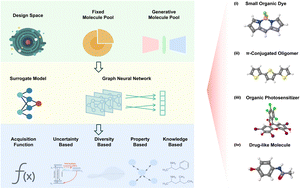
The design of high-performance photosensitizers for next-generation photovoltaic and clean energy applications remains a formidable challenge due to the vast chemical space, competing photophysical trade-offs, and computational limitations of traditional quantum chemistry methods. While machine learning offers potential solutions, existing approaches suffer from data scarcity and inefficient exploration of molecular configurations. This work introduces a unified active learning framework that systematically integrates semi-empirical quantum calculations with adaptive molecular screening strategies to accelerate photosensitizer discovery. Our methodology combines three principal components: (1) A hybrid quantum mechanics/machine learning pipeline generating a chemically diverse molecular dataset while maintaining quantum chemical accuracy at significantly reduced computational costs; (2) a graph neural network architecture and uncertainty quantification; (3) Novel acquisition strategies that dynamically balance broad chemical space exploration with targeted optimization of photophysical objectives. The framework demonstrates superior performance in predicting critical energy levels (T1/S1) compared to conventional screening approaches, while effectively prioritizing synthetically feasible candidates. By open-sourcing both the curated molecular dataset and implementation tools, this work establishes an extensible platform for data-driven discovery of optoelectronic materials, with immediate applications in solar energy conversion and beyond.
- This article is part of the themed collections: 2026 Chemical Science Covers and 15th Anniversary: Chemical Science Leading Investigators collection
 Please wait while we load your content...


