


Enabling plasmon-assisted ammonia synthesis: from mechanistic insights to catalyst design

Abstract
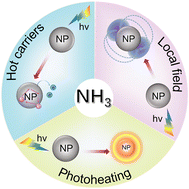
Ammonia is an important component in the manufacture of fertilizers and various chemicals, and its production mainly relies on the energy-intensive Haber–Bosch process. To overcome this, there has been growing interest in using photocatalysis as an alternative approach for ammonia synthesis under ambient conditions. Plasmonic nanomaterials have been considered to be particularly promising due to their localized surface plasmon resonance (LSPR) effects that combine the advantages of photochemical and thermal properties in one system. This review introduces the fundamental principles of LSPR effects, including hot carrier injection, photoheating and near-field enhancement. It then undertakes a comprehensive analysis of the current state-of-the-art catalysts for plasmon-driven photocatalytic ammonia synthesis. Finally, it proposes a brief outlook on the strategies for the design of plasmonic photocatalysts, advances in in situ characterization and theoretical simulations, standardization of the reaction conditions and detection technologies for ammonia production.
- This article is part of the themed collections: 2026 Chemical Science Perspective & Review Collection and 15th Anniversary: Chemical Science Leading Investigators collection
 Please wait while we load your content...


